
The expansion of K-Taxonomy (Korea's Green Taxonomy System) points to the future of green finance, a topic that businesses and investors should pay attention to.

As the climate crisis worsens, standards for "eco-friendliness" are becoming stricter worldwide. Now, simply claiming "eco-friendly" is no longer enough. This is where the Korean Green Taxonomy, aka "K-Taxonomy," comes into play.
Recently, the Ministry of Environment has been significantly expanding the scope of application of K-Taxonomy. This is directly related to corporate financing and represents a new milestone for our industry. Today, we will summarize four key points about K-Taxonomy: what it is, how it is expanding, and the impact it will have on the market.
1. What is K-Taxonomy? (The Boundary Between Green and Camouflaged Environmentalism)
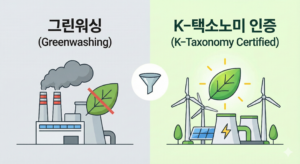
First, let's start with the basics. Simply put, K-Taxonomy is a national standard for determining what economic activities are truly eco-friendly.
The primary goal is to prevent "greenwashing," where companies promote their environmental friendliness solely through marketing, and to ensure that green funds flow to areas that actually contribute to environmental improvement. Technologies and industries that meet these criteria are eligible for financial benefits, such as preferential interest rates, when issuing "green bonds," making this an essential guideline for corporate survival and growth.
2. Expansion of the periphery: From nuclear power plants to defense and biodiversity
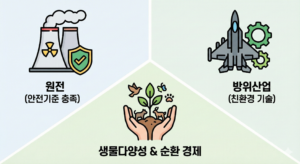
If the initial K-taxonomy was limited to clear eco-friendly industries such as renewable energy and zero-emission vehicles, the recent trend is ‘Expanding the scope for "realistic carbon neutrality"is in.
Including nuclear power: Nuclear power plants, the biggest issue, were included. While this came with stringent prerequisites, such as securing a high-level radioactive waste disposal facility and using accident-resistant nuclear fuel, it opened the way for green funding to flow into the nuclear power ecosystem.
Greening the Defense Industry (K-Defense): Recently, there has been a movement to apply K-taxonomy to the defense industry. Discussions are underway to recognize technologies that reduce carbon emissions during the production of weapons systems or use eco-friendly fuels as green economic activities.
Biodiversity and Circular Economy: Beyond simply reducing carbon emissions, the classification system is becoming more sophisticated, encompassing areas such as protecting natural capital and recycling resources.
3. Changes in Financial Markets: Green Bonds and the Shift in Investment
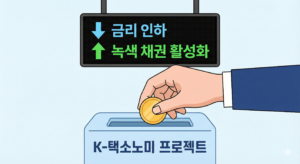
The most immediate change brought about by the expansion of the K-taxonomy is the "flow of money." Financial institutions are now considering K-taxonomy compatibility as a key criterion when deciding on investment targets.
Activating the green bond market: Companies implementing projects listed on K-Taxonomy can borrow funds at lower interest rates. This provides a significant incentive for companies in this era of high interest rates.
Pension and ESG funds: Major institutional investors, including the National Pension Service, have begun to consider K-Taxonomy compliance when constructing portfolios. This means that failing to meet this standard will make it difficult to secure investment.
Korean Green Bond Support Project: The Ministry of Environment is increasing practical benefits, such as subsidizing interest costs for small and medium-sized enterprises that issue bonds that comply with the K-taxonomy.
4. Future Outlook and Corporate Response Strategies

While the European Union (EU) taxonomy is considered a global standard, the expansion of Korean standards reflects the unique characteristics of our industry. However, challenges remain.
We need to "adjust the pace" to ensure alignment with global standards while avoiding abruptly disrupting the domestic manufacturing-centric industrial structure. Companies must move beyond simply avoiding regulations and adopting K-Taxonomy standards from the R&D stage, improving their systems so that products and services themselves can receive "green certification.".
In conclusion, the expansion of K-taxonomy is an opportunity, not a crisis. Only companies that read and prepare for this trend first will take the lead in the coming low-carbon economy.