
If you participated in the Hatchtech IPO subscription, can you rest assured simply because the offering price is at the lower end of the desired price band? It is difficult to sufficiently assess the post-listing stock price trend and allocation probability based solely on figures such as an institutional demand forecast competition ratio of 101.91 to 1 and a general subscription competition ratio of 25.73 to 1.
Hatchtech is a stock that requires a comprehensive analysis of the final offering price, institutional price proposals, reliance on mobile revenue, and post-listing trading volume. By examining the subscription schedule, minimum deposit, and conditions for the put option together, it becomes clear which aspects need to be prioritized before subscribing to the IPO.
Try to match the numbers, starting with the offering price and demand forecast.

Hatchtech's indicative offering price range was 23,000 to 28,000 won, and, The final offering price is 23,000 won, the lowest end of the band.It has been decided as follows. The number of shares offered is 1 million, the offering amount is approximately 23 billion won, and the estimated market capitalization based on the offering price is approximately 126.9 billion won.
321 institutions participated in the institutional demand forecast conducted from August 3 to 7, 2026, and the competition ratio was 101.91 to 1. The key point is that while 57.91 institutions offered a price above the upper end of the band, the final price was set at the lower end rather than the upper end.
Therefore, it is difficult to conclude that subscription enthusiasm was strong based solely on the fact that the institutional competition rate was in double digits. Given that the price bid distribution differed from the final offering price, the scale of institutional participation and the price determination results must be interpreted separately.
Although Hatchtech's IPO price was set at the lower end of the indicative band rather than being inflated, the lower end of the price band is not a mechanism to protect the stock price after listing.
Divide your business content into mobile revenue and new business.
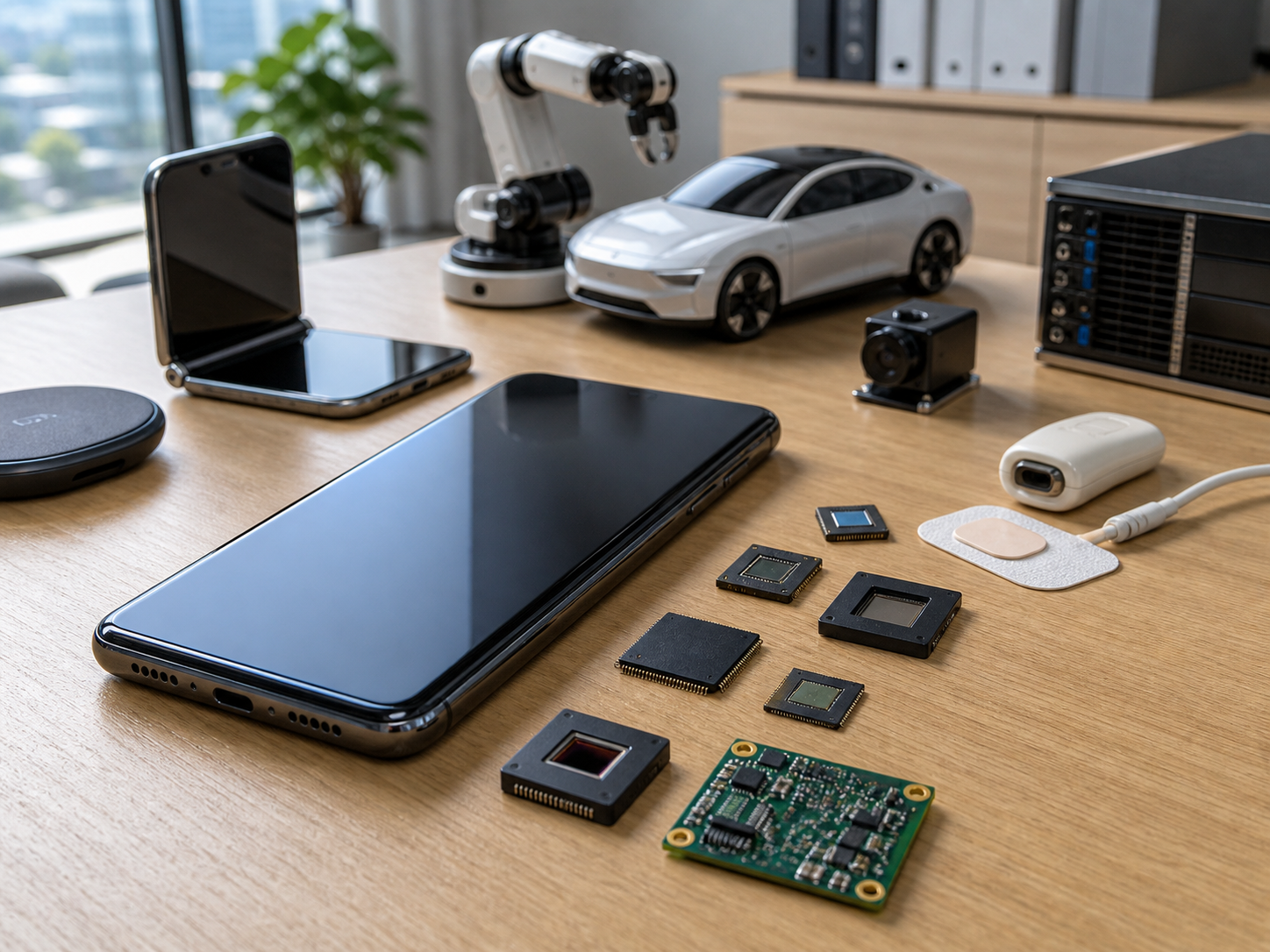
Hatchtech is a fabless company specializing in semiconductor sensor IC design, established in 2017. It designs geomagnetic sensor ICs, digital magnetic sensor ICs, analog magnetic sensor ICs, and temperature and humidity sensor ICs, while outsourcing production to external foundries.
In 2025, sales were accounted for by approximately 63.71 TP3T for geomagnetic sensor ICs and approximately 31.61 TP3T for digital magnetic sensor ICs. Since the combined sales of these two products exceed 951 TP3T, current performance is largely tied to demand related to mobile devices such as smartphones.
Smartphone electronic compasses are a representative application, and the scope of application is expanding to include foldable hinge state detection, wireless charging accessory recognition, and sensors for camera gimbals. The company stated that it supplies its products to over 60 clients and three of the top five global Android smartphone manufacturers.
Robot encoders, current sensors, medical temperature sensors, AI servers, and automotive electronics are currently targets for expansion rather than being the core of revenue. Since the company's stated goal is to reduce the proportion of mobile revenue from 851 TP3T in 2024 to 401 TP3T in 2030, subscribers should distinguish between current performance and mid-to-long-term plans.
| division | Key figures | Reading criteria |
|---|---|---|
| Institutional demand forecasting | 321 institutions, 101.91 to 1 | Check the scale of participation and the price proposal together. |
| Present at the top of the band | 57.9% | A separate determination is made as to whether the final offering price was set at the upper end. |
| General subscription | 250,000 shares, 25.73 to 1 | Calculate by dividing the possibility of equal and proportional allocation |
| Minimum subscription conditions | 20 shares, margin 230,000 won | Fees and account conditions are also reflected |
Read the institutional and general subscription competition rates based on the allocation criteria.

Of the total 1 million shares offered, 250,000 were allocated to retail investors and 750,000 to institutional investors. Approximately 6.43 million shares were subscribed, resulting in a final competition ratio of 25.73 to 1.
DB Securities is the lead underwriter, and the minimum subscription quantity is 20 shares. Based on a margin rate of 50%, the minimum margin is 230,000 KRW. Equal allocation depends on the number of accounts participating in the minimum unit, and proportional allocation is influenced by the number of shares applied for and the overall competition rate; therefore, the actual number of allocated shares cannot be calculated based solely on the competition rate.
Although the institutional lock-up commitment ratio is mentioned in the data as 15.081 TP3T, the criteria stated in the final securities registration statement and allocation results must be applied when evaluating subscriptions. While a higher lock-up commitment may reduce initial selling volume, it does not guarantee actual trading volume or the direction of the stock price.
Please check the subscription schedule and repurchase right conditions separately.

The announced schedule was institutional demand forecasting from August 3 to 7, general subscription from August 12 to 13, refund and payment on August 18, and KOSDAQ listing on August 25. As of the time of subscription, DB Securities was the lead underwriter, and subscription fees and account opening conditions are applied based on the announcements made by the respective securities firm.
A put option is a system that allows investors to sell their shares back to the lead underwriter under certain conditions when the price of an IPO falls. However, this right is not automatically applied to all investors and all shares, and, Eligibility · Event Period · Event Price · Application ConditionsIt will be exercised only within the scope defined in this securities registration statement.
‘You should not understand that the principal is guaranteed simply because there is a put option. You may be excluded if you have sold the shares or fail to meet the exercise requirements, and since this does not mean you will receive the full offering price back, you must take the detailed conditions of the final disclosure into account when deciding whether to subscribe.
After listing, please check the circulating supply and actual trading.

Even if the offering price is set at the lower end of the band, the risk of a stock price decline after listing remains. Given that HatchTech traded significantly below the offering price on its first day of trading on August 25, 2026, post-listing performance should not be predicted based solely on the offering price level.
On the day of listing, you should examine the opening price formation process and trading volume before looking at the stock price. By observing whether sell orders are released rapidly, whether trading volume concentrates in specific ranges, and whether a Volatility Interruption (VI) mechanism is triggered, it is easier to identify the direction of supply and demand rather than simple price fluctuations.
The number of shares scheduled for listing was presented differently in the data, with figures of approximately 5,517,150 and 5,517,510. For items with conflicting figures, the confirmed details from the final securities registration statement and the KIND disclosure by the Korea Exchange must be used as the basis, and the volume under lock-up and the actual number of tradable shares must be interpreted separately.
The largest shareholder is CEO Choi Seong-min, with a stake of 50.91 TP3T, and a stake of 59.91 TP3T including related parties. By examining the lock-up period for the largest and existing shareholders, the volume subject to mandatory institutional holding commitments, and the circulating volume of public offering shares in sequence, one can more concretely assess the selling pressure during the initial listing period.
Organize your final decision before applying in this order.
First, you need to examine whether the fixed offering price of 23,000 won is burdensome compared to the company's current performance and reflect the business structure, which has a high proportion of mobile sensor sales. For the robot, AI server, and automotive electronics businesses, the starting point is to distinguish between the content presented in the growth plan and actual sales.
Next, examine the institutional competition rate of 101.91 to 1 and the general subscription competition rate of 25.73 to 1 from an allocation perspective, and calculate the 230,000 won required for a minimum subscription of 20 shares, along with the fees. Finally, by examining the put option, lock-up period, circulating volume, and trading volume on the listing day as a package, you can avoid making a judgment based on a single number.
Hatchtech's strengths lie in sensor IC design technology and customer expansion, but its current performance is concentrated on mobile products.It is already set up. Before subscribing, the key is to first verify the current status of business revenue and the feasibility of new businesses, rather than focusing on the fact that the offering price is at the lower end.