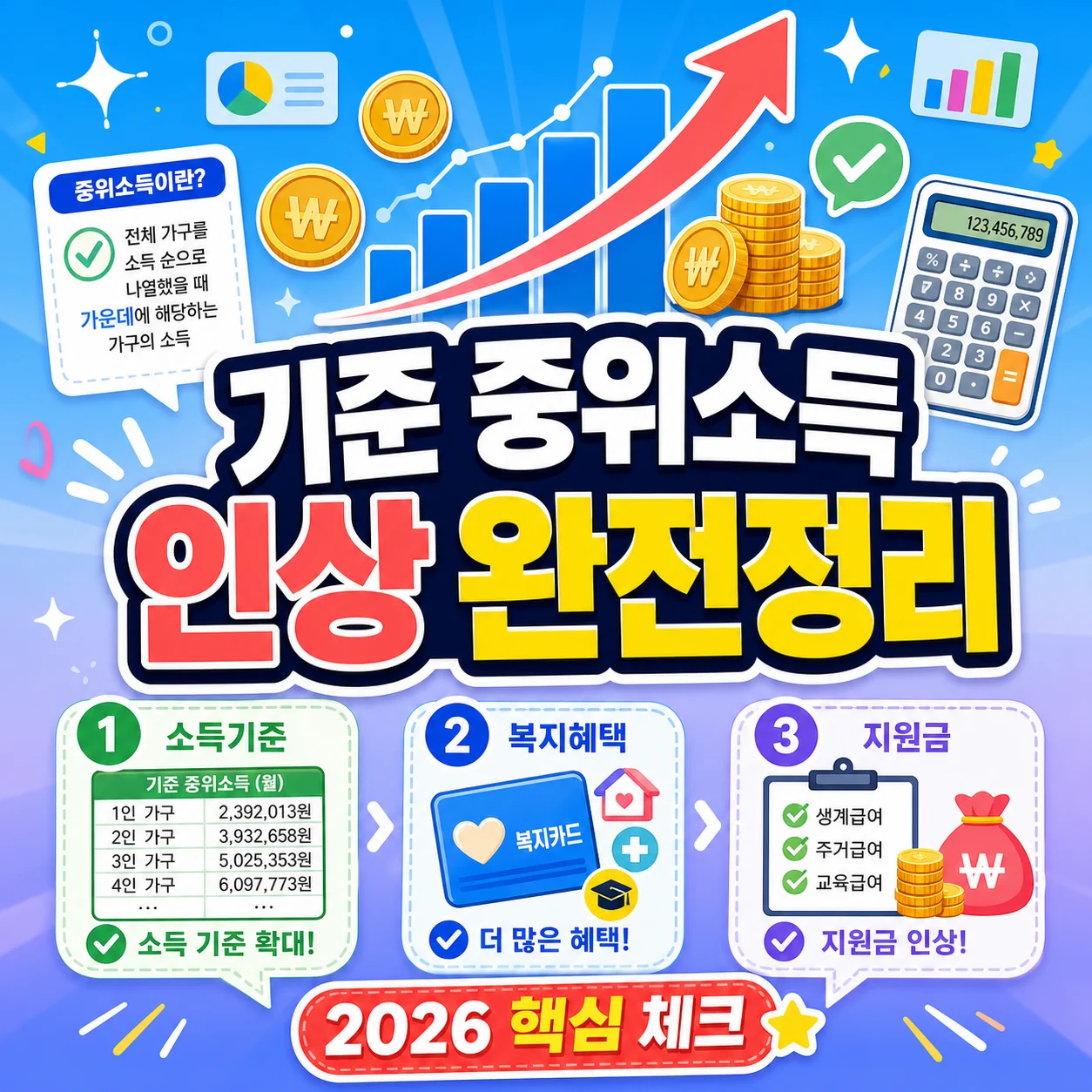
Standard median income은 Welfare benefit selection criteriadividing Key numbersIt is. In 2026, the increase was significant for both single-person and four-person households, and, The standards for livelihood benefits have also risen. The perceived change has increased.
This increase is not a simple price adjustment Basic livelihood security, housing, medical, and education benefits It affects the overall. Today I wonder how much it went up와 Who is affected and whatLet's summarize it together.
As of 2026, the median income rose across all household sizes, with the increase being particularly pronounced for single-person households. Since this figure is directly linked to the eligibility criteria for livelihood, medical, housing, and education benefits, it is the first thing to check when verifying eligibility for welfare.
How much has the median income risen by 2026?
As of 2026, the median income has generally increased compared to the previous year. A four-person household earns 6,494,738 won per monthIt rose to 6.511 TP3T, and, A single-person household earns 2,564,238 won per month.It was increased to 7.20%.
It is also noteworthy that the perceived rate of increase appears greater the smaller the household size. In particular, since single-person households account for a significant proportion of households receiving basic livelihood support, The width connecting this adjustment to the actual protection rangeThis is big.
| Number of household members | 2025 | 2026 | Impression rate |
|---|---|---|---|
| 1 person | 2,392,013 won | 2,564,238 won | 7.20% |
| 2 people | 3,932,658 won | 4,199,292 won | 6.78% |
| 3 people | 5,025,353 won | 5,359,036 won | 6.51% |
| 4 people | 6,097,773 won | 6,494,738 won | 6.51% |
As shown in the table, two-person households also rose to the upper 61 TP3T range, and three or more people are generally at the 6.511 TP3T level. Because the baseline varies depending on the number of household members It is important to accurately determine the amount that fits your family composition.
How are the standards by salary connected?
The standard median income is not a standalone criterion, but serves as the basis for selection criteria by benefit level. Currently, Livelihood Benefit 32%, Medical Aid 40%, Housing Allowance 48%, Education Allowance 50% The structure is being maintained.
In other words, as the median income rises, the threshold for each salary also rises. Cases where income appears slightly higher than before but qualifies based on this year's standardsSince this may occur, it is recommended to check at every renewal period.
| Types of salary | Median income standard ratio | meaning |
|---|---|---|
| livelihood benefits | 32% | Standards for guaranteeing a minimum standard of living |
| Medical benefits | 40% | Criteria for Determining Medical Expense Support |
| Housing allowance | 48% | Rent and housing repair support criteria |
| Education allowance | 50% | Criteria for Determining Educational Activity Support Expenses |
This structure is better than the amount that changes every year Ratio systemIt also means that understanding it is more important. Where my income standsYou can make a decision much faster by looking at it first and then comparing it with the relevant salary standards.
How much has the livelihood allowance changed?
For livelihood benefits, changes are direct because the selection criteria are the minimum guaranteed level. In 2026, 820,556 won for a single-person household, 4-person household 2,078,316 wonIt has been upgraded to.
This amount does not directly represent the actual payment, but it is important as it serves as a baseline for determining eligibility. Since the recognized income must be lower than this standard to be eligible for livelihood benefits, You must examine the number of household members, income, and assets together.
Increase in standard median incomeWith the adjustment of the system taking place simultaneously, an expansion of eligibility is also expected. According to the press release, it was mentioned that approximately 71,000 people could potentially receive livelihood benefits for the first time.
Who feels it more easily?
This correction is especially single-person households와 low-income working householdsThis is keenly felt. This is because single-person households have a high proportion of recipients, and often fall within the threshold depending on income fluctuations.
In addition, young people and households with earned income can see the combined effects of expanded deductions and system improvements. Rather than simply looking at the median income figures You must also check income deductions, vehicle criteria, and dependent criteria to more accurately determine your actual eligibility.
It is easy to understand if you look at it as shown below.
| Target | Feeling points | Parts to check |
|---|---|---|
| single-person households | The increase in standards is large | Eligibility for livelihood benefits and medical benefits |
| Young working households | Impact of expanded income deductions | Method of reflecting earned income |
| Vehicle-owning households | Property criteria need to be verified | Vehicle conversion standard |
What parts should we check together?
If you look only at the standard median income, it amounts to looking at only half. In actual welfare assessments... Number of household members, Recognized income, Property conversionThis is calculated together.
Items where detailed criteria overlap, such as vehicle or dependent conditions, are particularly easy to overlook. The reason why it needs to be re-verified based on this year's standardsIt is right here.
To summarize It is correct to view the increase in median income by 2026 as a change that widens the baseline of basic livelihood security again, rather than the number itself. An amount that fits the number of my household membersIt becomes much easier to make a judgment if you find it first and then apply the ratios by salary.
If you are looking into eligibility for welfare benefits Median income increase, livelihood allowance baseline, Additional conditionsIt is advantageous to view up to this point as well. For people like this This adjustment is the starting point for actual qualification verificationThis could be it.
Frequently Asked Questions
How much has the median income risen by 2026?
As of 2026, the median income generally increased compared to the previous year, with the median income for one-person households rising by 7.201 TP3T to 2,564,238 won. The median income for four-person households rose by 6.511 TP3T to 6,494,738 won.
Why is raising the standard median income important?
This is because the standard median income is directly linked to the eligibility criteria for livelihood, medical, housing, and education benefits. If this figure rises, the thresholds for each benefit also increase, affecting eligibility for welfare.
How have the livelihood allowance standards changed in 2026?
The eligibility criteria for livelihood benefits in 2026 have been raised to 820,556 won for a one-person household and 2,078,316 won for a four-person household. Eligibility can only be reviewed if the recognized income is lower than these standards.
What should be considered together when verifying welfare eligibility?
You should not rely solely on the standard median income; you must also check the number of household members, recognized income, and converted assets. Since vehicle ownership criteria and dependent eligibility conditions can also have an impact, it is advisable to review the detailed criteria as well.